A clinical debate in Kenya’s nephrology community deserved a proper, documented answer.
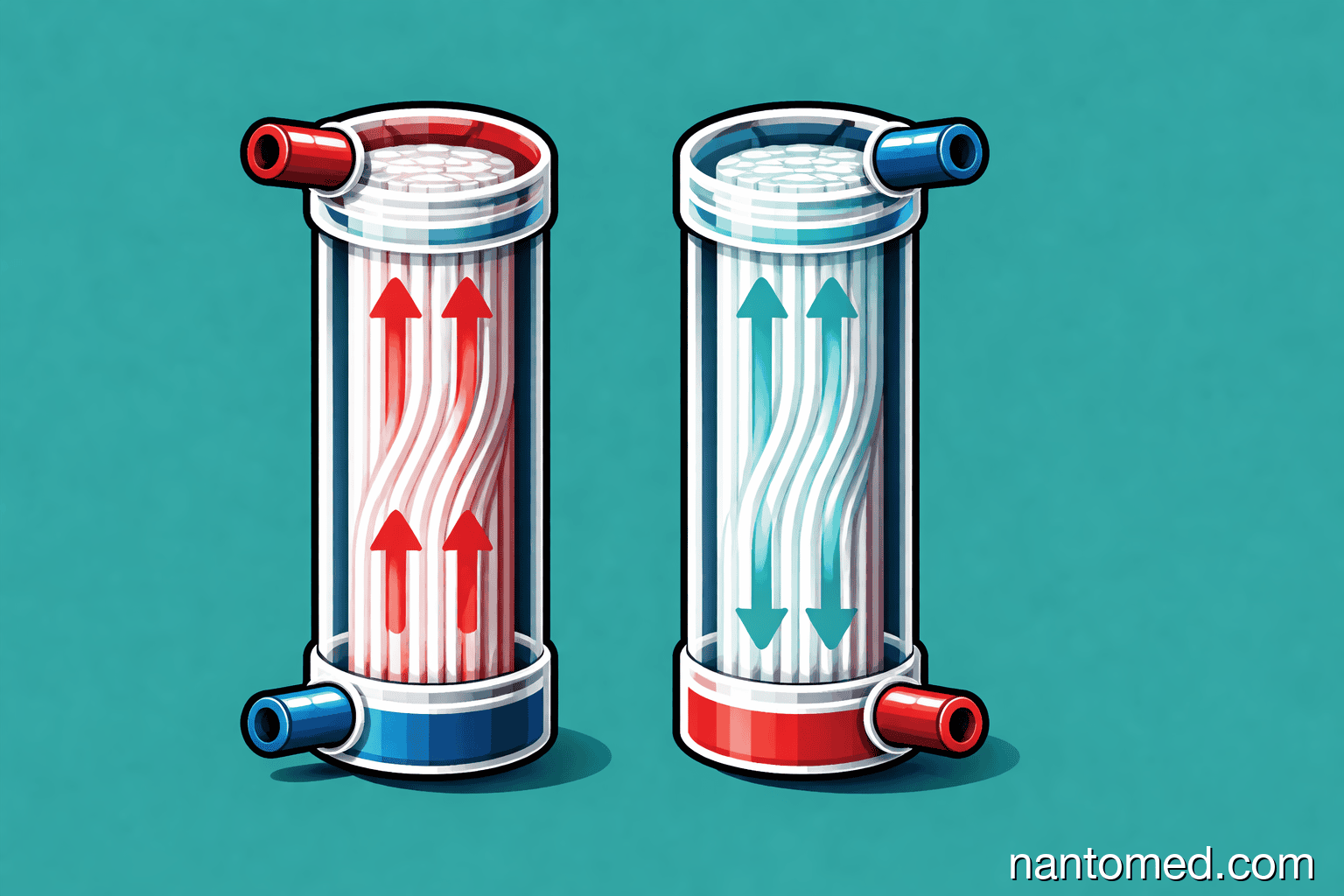
Couple weekends, Kenya’s nephrology nursing community was engaged in a debate that’s worth a proper answer. The question: does it matter which end of the dialyzer faces up during treatment? The red (arterial) end or the blue (venous) end? And does that orientation affect how well dialysis clears toxins from the blood?
It’s a genuinely good clinical question. We went looking for what the documentation says.
The Clinical Question
Every dialyzer has two ends: the arterial port (red) where blood enters, and the venous port (blue) where blood exits. When the dialyzer is mounted on the machine, one end points up. The debate is whether this matters, either for clearance during the session, or during specific moments like priming or blood return.
Some nurses argue that orientation affects countercurrent flow and therefore toxin removal. Others follow the practice of their senior colleagues without documented backing. Experienced clinicians have good instincts, but instincts deserve documentation.
What the Debate Got Right
The nurses who raised the countercurrent argument were showing genuine clinical sophistication. Countercurrent flow (blood and dialysate traveling in opposite directions) is not a minor detail.
The literature is clear: co-current flow (both fluids moving in the same direction) results in approximately 20% less diffusive clearance of small molecules like urea and creatinine. [1] The nurses who insisted that connection orientation matters are correct. Counterflow is critical. And the senior clinicians who said “follow manufacturer instructions” are also correct. That instinct is exactly right, it just needs documentation to back it up.
What the Manufacturer Documentation Says
We searched for documentation across the machines most commonly referenced in this debate.
Biolight BM-4000
This is the machine that started the conversation, and it is the one we could not find a public manual for. We searched Biolight’s official website (global.blt.com.cn), their product listings, and third-party documentation repositories. We found documentation for the D800 series but nothing for the BM-4000 specifically.
We want to name this gap directly: if this machine is in use in Kenyan public hospitals, the nurses and biomedical engineers operating it deserve access to a clear, readable user manual. That documentation gap is itself worth flagging. We also welcome correction. if you have the Biolight BM-4000 manual and we have something wrong, please send it our way.
Fresenius 5008 Cordiax and 4008S
Both machines have publicly available user manuals. [2] We reviewed these and found that neither machine manual specifies dialyzer orientation (red end up vs. blue end up) as an explicit treatment step. This is not unusual. Machine manuals address how to connect lines to the machine, not how to orient the dialyzer housing itself. That guidance typically lives in the dialyzer’s own Instructions for Use (IFU), the document inside the dialyzer packaging, produced by the dialyzer manufacturer. [3]
Baxter Artis Physio Plus (formerly Gambro Artis)
The Gambro Artis user manual in our reference library does not contain explicit dialyzer orientation instructions. Baxter’s renal division has since rebranded under Vantive, and current documentation access was limited in our search.
The practical pattern across all three machines is consistent: machine manuals focus on circuit connection and setup. Dialyzer orientation guidance belongs in the dialyzer IFU. Both documents should be in your unit.
The Science Layer
Here is where we can speak to what the literature says, and where we need to be honest about what it does not say.
Does orientation (red vs. blue end up) affect clearance?
The evidence says no, not in a clinically significant way. Both blood and dialysate flow are driven by pumps, not gravity. The concentration gradient that drives diffusion is maintained by those pumps regardless of which end faces up. KT/V and URR (the standard measures of dialysis adequacy [4]) are the same whether the red or blue end points toward the ceiling.
Then why does orientation matter at all?
Because of air. When the blue (venous) end faces up, blood enters from the bottom and travels upward through the hollow fibers. This upward flow helps push microbubbles out through the venous port and into the venous air trap. When microbubbles remain trapped in the fibers, they block capillary surface area. Not enough to show dramatically on a single session’s clearance measurement, but enough to reduce effective membrane surface over time and increase clotting risk in those fibers.
What about gravity and the countercurrent argument?
Gravity does not meaningfully affect diffusive clearance in pump-driven systems. The countercurrent advantage is a function of how lines are connected to the ports, not of which end physically points up. Some theoretical work notes that fluid pressure may be slightly higher at the base of a vertical membrane, but this is not documented as clinically significant in standard hemodialysis practice.
Does orientation change during retrace (blood return)?
We found no specific manufacturer guidance recommending a change in dialyzer orientation during blood return. Standard practice maintains the normal treatment position throughout.
One scenario where inversion is used: priming
Some priming protocols recommend briefly inverting the dialyzer (arterial end pointing down) during the priming rinse to optimise air expulsion before treatment begins. After priming, the dialyzer is returned to venous-end-up position. This is a priming technique, not a treatment orientation. If your unit uses this method, it is legitimate. The key is that the dialyzer returns to blue-end-up before treatment begins.
The Practical Takeaway
Mount the dialyzer with the blue (venous) end up during dialysis. This is the consistent standard across the machines we reviewed and aligns with the physical rationale: upward blood flow assists air removal and protects fiber surface area. This does not change your clearance numbers directly, but it protects the dialyzer’s effective performance across the session.
More importantly: ensure countercurrent flow is correctly established by connecting arterial and venous lines to the correct ports. That connection has a documented 20% impact on clearance. The physical orientation of the housing does not.
Read your dialyzer’s IFU, the document inside the dialyzer box. That is where your manufacturer’s specific orientation guidance lives. And if you do not have the user manual for your machine, get it. Your biomedical engineer or equipment supplier should provide it.
From Nanto Med
At Nanto Med, we are equipment experts, not clinicians. We supply dialysis parts and we know these machines. When a debate like this one emerges from Kenya’s nephrology community, our role is to go to the documentation layer and report back honestly, including when documentation is missing.
If your unit is running a Biolight BM-4000 or any other machine without a user manual readily available, reach out to us. We will work with you to locate it or connect you with the right channel. That is part of what we are building.
Do you work with a dialysis machine whose manual you can’t locate? Tell us the model in the comments.
This article is produced by Nanto Med for educational purposes. We are equipment suppliers, not clinicians. Nothing here constitutes clinical guidance.
References
[1] Countercurrent vs. co-current flow and dialyser clearance, Deranged Physiology
[2] Fresenius 5008 Service and User Manual (Frank’s Hospital Workshop, free public resource for biomedical engineers)
[3] Fresenius Optiflux Dialyzer, Product and IFU information
https://www.freseniusmedicalcare.com/en/patients/treatments/hemodialysis/dialyzers/optiflux/
[4] Hemodialysis Adequacy, KT/V and URR (StatPearls, NCBI)